
Why is the Persian carpet popular?
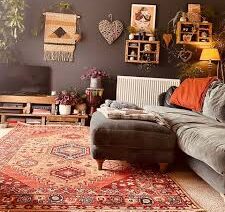
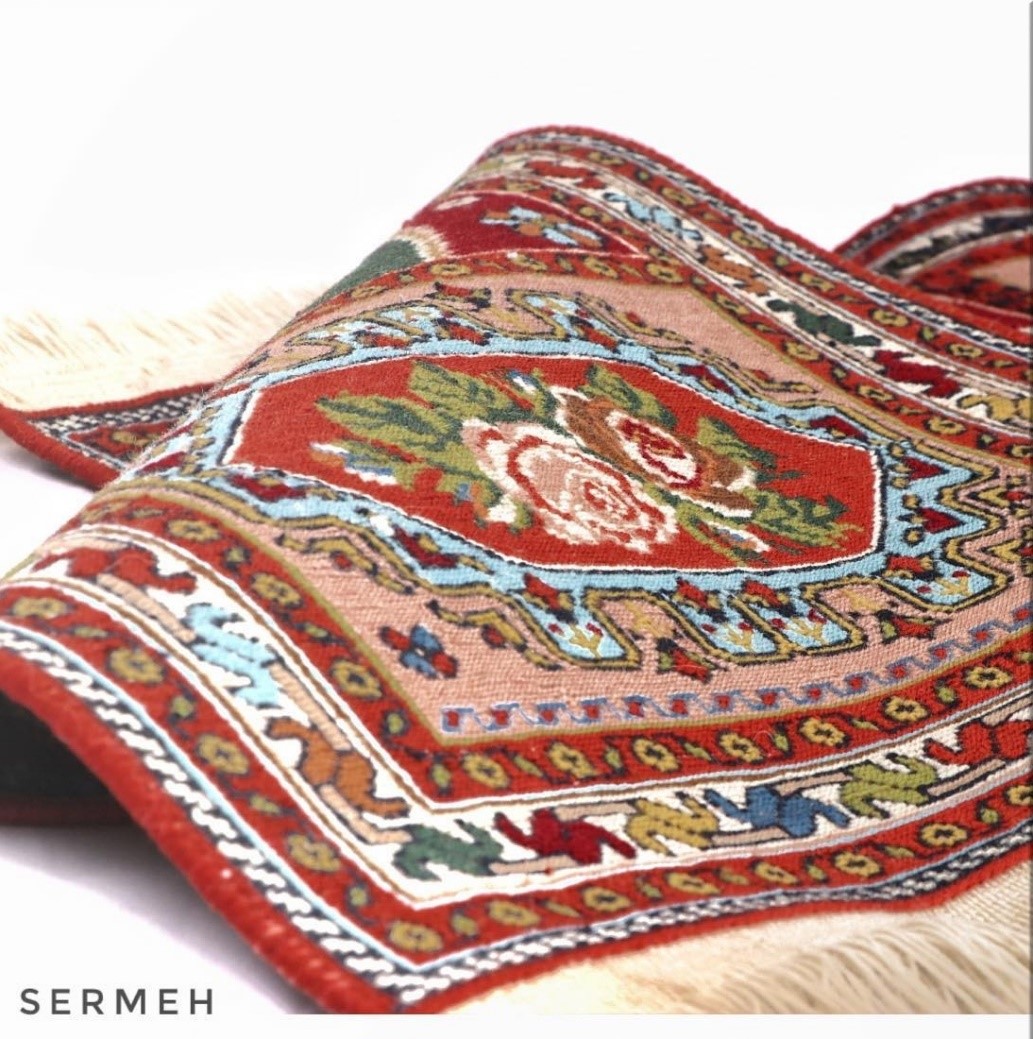
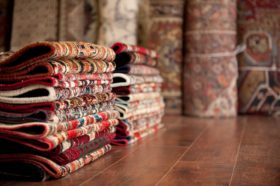 If you have ever been to one of the carpet markets, you must be excited to see a world of patterns, colours, and beauty. Seeing all that art and beauty in a two-by-three or three-by-four frame, or any other shape and dimension, may encourage anyone to buy a Persian carpet or a board from those beautiful rugs, either for use or for its decorative aspect.
Today, one of the most valuable and important items in Iranian and foreign homes is the carpet. From ancient times, the Persian carpet designs have been famous all over the world, and people would buy Persian carpet. So to buy a rug, you need information about how to buy a rug, tips to follow when buying, and even how to maintain a rug.
Iran is one of the leading countries in carpet production and has a long history in textiles and weaving. Carpets have always been symbolic products of Iran and exported worldwide. Iran is known as the most famous producer of carpets, especially handmade ones, among many nations.
*Buy Persian Carpet*
Buy a Persian carpet for your home
One of the main reasons Iranian handmade rugs attract global attention is their rich and diverse colours. Their materials are high-quality and carefully selected. These rugs show refined craftsmanship and artistic elegance. Their vivid, natural colours and unique patterns create strong visual appeal. All these qualities make Iranian carpets famous and highly popular worldwide.
History of Persian carpet
Persian rugs or carpets have long been famous and used, as evidenced by the Greek historian Xenophon in his book Cyrus, between 430 and 345 BC: “Iranians spread rugs under their beds to keep their beds soft.”
The Chinese yearbook of Suisu in the Sassanid period mentions Iranian woollen carpets as imported goods to China.
Although some intend to link the history of carpet weaving to Turkish art and the tribes of Central Asia, the discovery of the Pazyryk rug, the oldest known example of a rug in the world, is found in Achaemenid motifs in the frozen tomb of a Scythian ruler in the Pazyryk Valley. Found 80 km outside of Mongolia disproves this claim. Cyrus Parham denies this claim.
The famous Greek poet and epic poet of the seventh century BC (Xenophon) mentions a throne covered with a purple carpet. Other historians, poets, and writers have also mentioned in their writings that Iranians have a habit of resting on very soft carpets.
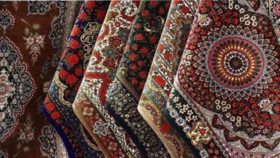 Carpet experts believe that carpet weaving and carpet weaving and weaving of all types of carpets originated in Asia. Researchers say that Iran, Turkistan, and the Caucasus are the primary cradles of the art of carpet weaving. From the writings of some texts, it is understood that the art of carpet weaving existed long before Christ.
A simple survey shows that many countries value the carpet industry. Turkey, Spain, Turkmenistan, Afghanistan, and the Caucasus all have strong weaving traditions. Pakistan, India, Egypt, China, Romania, and the Balkan regions are also active in carpet production.
In 15th-century European Christian paintings, most carpets shown came from Anatolia and the Caucasus. Surviving 13th- and 14th-century Christian carpets were also from the Caucasus and Asia Minor. No pre-Safavid examples of Iranian weaving were known then. At that time, the Pazyryk carpet had not been discovered yet. Many believed carpet weaving was only a thousand years old, and its fame in Iran came from the Safavid rulers.
*Buy Persian Carpet*
Historical handmade carpets
Baharestan Carpet
The Baharestan carpet, belonging to the Sassanid period, also known as Bahar Khosrow, Baharaksari, and Mahestan, is one of the most important works of art in Iran, which was torn to pieces by the Arabs in Iran and transferred to Medina by the Arabs. This carpet is located on Kasra’s porch and is 140 meters long and 27 meters wide. In the texture of this carpet, silk, gold, silver, and jewels such as emerald and pearl are used, and its design shows one of the gardens of paradise.
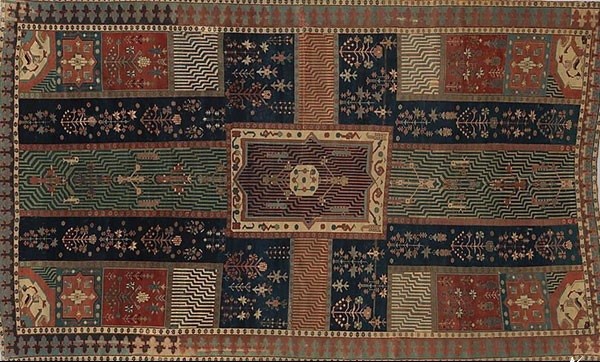
Reconstruction of the Baharestan carpet
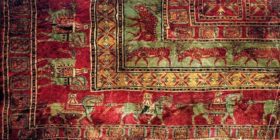
Pazyryk rug:
Scholars consider the Pazyryk rug to be a part of the Parthian or Median textiles of the Achaemenid period. Currently, 40% of Iranian carpet exports are made through East Azarbaijan province.
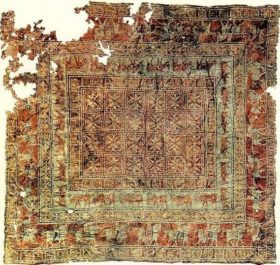
In this carpet with dimensions of approximately 2 square meters (210 × 183 cm), the colours used in this carpet are green, brick, dark red, blue, and brown. Of course, the passage of time has caused a change in the colour of the carpet. The only reason that has kept the carpet relatively healthy is the severe frost in the Altai Valley region.
Countless pieces of evidence show that this carpet is Iranian. Persian spotted horses and deer and deer, all of which belong to a special Iranian breed. Also, the style of work (knitting) is the method of Iranian carpet weaving. The use of different colours and their symmetry shows that this carpet is woven in a well-equipped workshop and follows a precise pattern.
According to archeological excavations, this carpet belongs to the Achaemenid period. It was discovered by Professor Rudenko, a Russian archaeologist, while excavating the Scythian tombs of the Pazyryk region.
After carefully studying and analyzing the style of weaving and patterns and comparing them with other woven works of that time, Rodenko considers this carpet to be one of the woven fabrics of Achaemenid Iran. However, many have sought to attribute some of the relics of ancient Iranian civilization to other lands.
It was after the discovery of this rug that many experts came to believe that the texture of rugs with such characteristics requires strong cultural and artistic support. They even emphasized that for many centuries before the weaving of this rug, this profession was prevalent on the plateau of Iran.


Safavid handmade carpets:
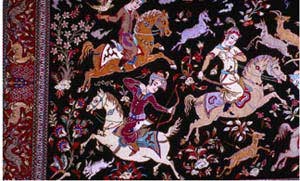
It is one of the most beautiful Iranian handmade carpets that shows the creativity and genius of artists during the Safavid rule. During this period, carpet weavers left about 1500 carpets and rugs using various designs.
Anjasan Anjara Carpet:
A carpet with a red background without elastic that has only the middle bergamot. The rug-like pattern of the rug gives it a Chelsea-like look. The fabric of this carpet is made of silk, and its lint is made of wool. The place of storage of this carpet is the Museum of Milan, Italy, and it is the work of weavers in the northwest of Iran.
 Chelsea rugs:
 Chelsea rugs:
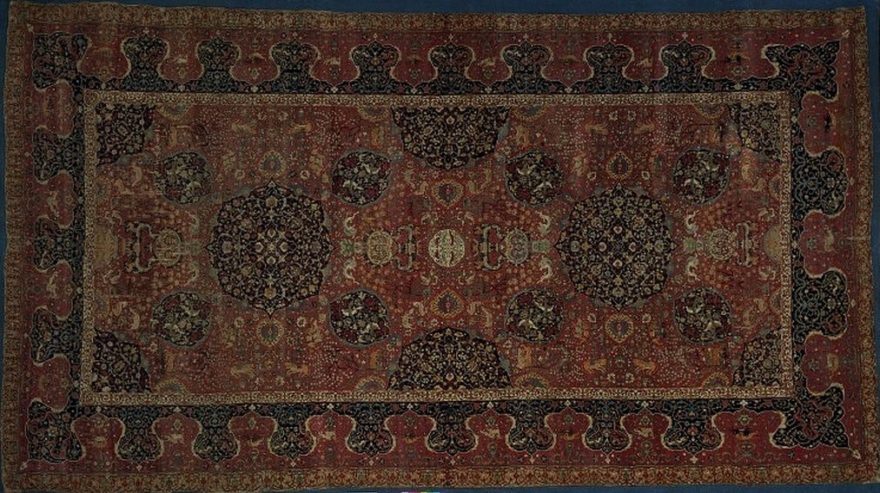
The Chelsea rug, one of the most prestigious hand-woven fabrics in Iran and the world, is kept in the Victoria and Albert Museum in London. This carpet belongs to the Safavid period and the flourishing era of Iranian art.
Chelsea silk carpet yarn. Its lint is wool, and its dimensions are 540 by 360 cm, and its knots are of the Persian symmetrical type.
In the center of the carpet, there are two complete bergamots with marginal bergamots. You can see animals such as deer, gazelle, lion, and leopard in the background and center of the lacquer carpet.
Ready to bring the elegance of an authentic Persian carpet into your home? Explore our exclusive collection of handwoven masterpieces crafted by skilled Iranian artisans. Each piece is unique, timeless, and designed to elevate any interior with warmth and sophistication. Click below to discover your perfect carpet and buy your Persian carpet today with confidence and worldwide shipping. Your home deserves art—let’s help you find it.